
Camera Lens Aperture Explained: What Do f/1.4 and f/2.8 Change?
A smaller f-number describes a wider maximum aperture, not a promise that every photograph will look better. Start with the subject and the picture you need.
Read the maximum, then choose your working setting
Sony explains that aperture controls the opening through which light enters, and that a lens’s lowest f-number describes its maximum aperture. The number in a lens name is therefore a capability, not an instruction to shoot every scene at that setting.
A wider aperture can help when you want a shallow zone of focus. A narrower aperture can help keep more depth acceptably sharp. Subject distance, focal length and the picture’s arrangement also matter. Avoid deciding that two lenses will produce identical backgrounds simply because the same f-number appears on both.
Different pictures need different tradeoffs
For a portrait, decide how much of the face and surroundings must remain in focus. For a group photograph, people standing at different distances create a different requirement. For a product photograph, decide whether you want the whole object readable or a deliberately isolated detail.
A Kenyan event photographer comparing a fast prime with a zoom is choosing more than aperture. A prime’s framing can require changing camera position, while a zoom offers a range of focal lengths. Consider access to the subject, how quickly framing changes, and whether another lens change would interrupt the job.
Do not make aperture do every job
Aperture is only one exposure control. A moving person also requires an appropriate shutter speed, and focus still has to land on the intended subject. A brighter lens does not automatically cure missed focus, subject movement or a badly placed light.
When comparing the saved Maximum Aperture and Focal Length fields, also check mount and format compatibility. For a zoom, confirm whether the maximum aperture stays constant across its range. Ask for an example at your intended framing and working aperture, rather than buying on a single large number in a title.
Compare the decision, not one label
| Decision | What to check |
|---|---|
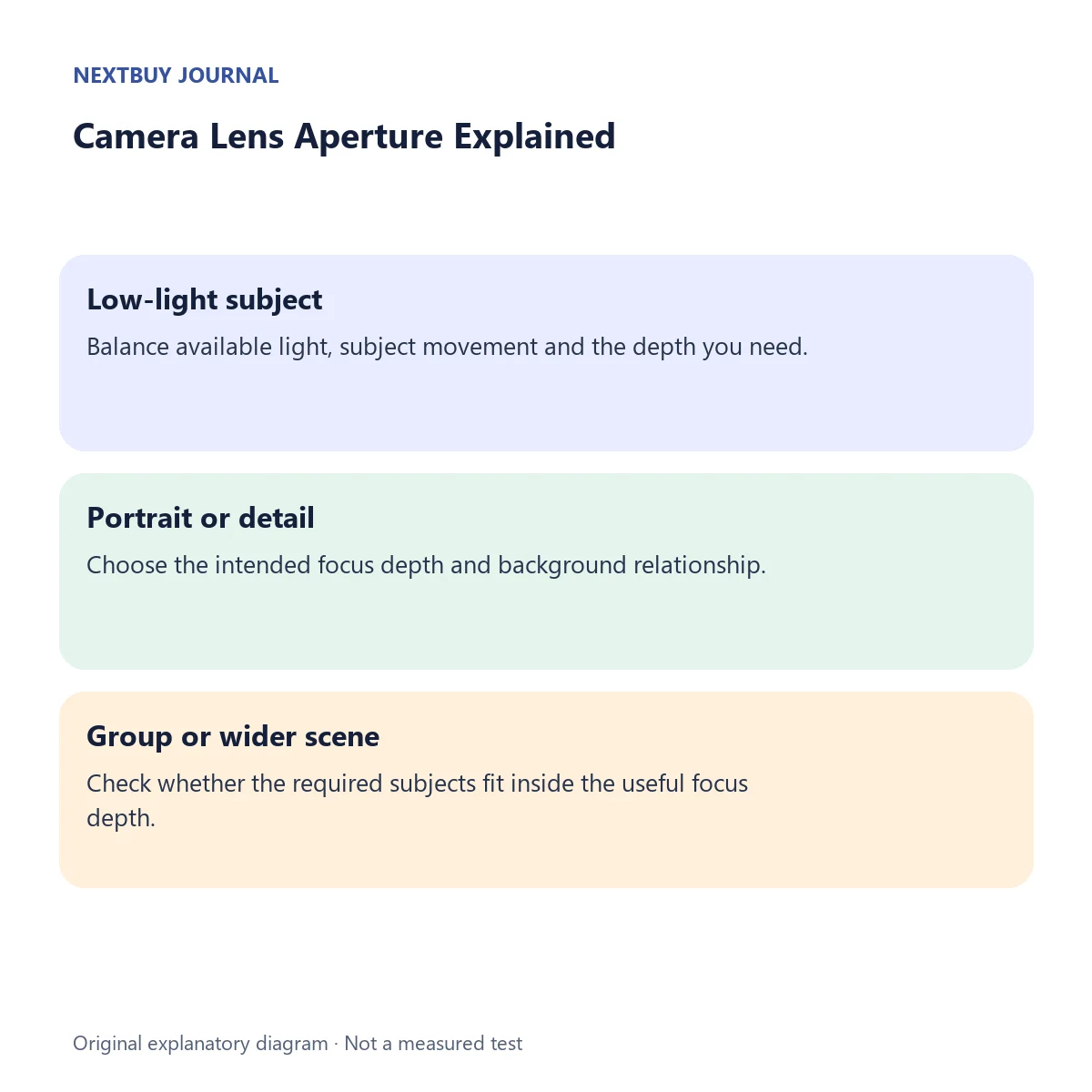
| Low-light subject | Balance available light, subject movement and the depth you need. |
| Portrait or detail | Choose the intended focus depth and background relationship. |
| Group or wider scene | Check whether the required subjects fit inside the useful focus depth. |
Before choosing
- Specify the camera body, subject distance and focal length you expect to use.
- Compare the actual maximum-aperture behaviour across a zoom’s range.
- Confirm the mount and format before weighing price or lens-tier names.
Questions readers ask
Does f/1.4 mean I must use f/1.4?
No. It states a maximum capability; choose the working aperture for the photograph.
Will a wider aperture fix every blurry photo?
No. Focus, subject movement, camera movement and exposure choices remain separate checks.
Read a real lens specification
The current Sony FE 50mm f/1.4 GM record separates its 50mm focal length, f/1.4 maximum aperture and f/16 minimum aperture. It is a Sony E-mount, full-frame prime. Read those fields together: the largest opening is one end of a range, while focal length and compatibility answer different questions.
Sony FE 50mm f/1.4 GM
Open the lens listing to confirm the current offer and supplied package. Check the exact camera-body compatibility before ordering. Browse camera lenses to compare populated aperture and focal-length fields.