
Drone Flight Time Explained: Why the Battery Also Changes Weight
Compare the battery behind a flight-time claim, not just the largest minute figure. A different battery can change the aircraft’s weight and the way you plan a flight.
The headline has a test behind it
Antigravity lists the A1 at 249g with its standard flight battery and 291g with its high-capacity battery. Its corresponding maximum-flight-time figures are 24 and 39 minutes. These are controlled-test maxima: the manufacturer tested in still air at 25°C, flying forward at 6m/s below 50m with video recording disabled, until low-battery automatic landing. Its selected video setting was 5.2K/30fps. Results vary; these figures do not promise 24 or 39 minutes of recorded footage.
These are two configurations of one aircraft, not two durations you can combine into one flight. A multi-battery bundle provides separate flights and charging logistics; it does not let the aircraft swap batteries while airborne.
Separate maximum duration from usable shooting time
Plan the sequence you need: setup, takeoff, positioning, recording, return and landing. Treat the manufacturer’s maximum as a comparison under its stated test, rather than a promise that all of those stages leave the same number of filming minutes in your location.
For a Kenyan creator travelling between locations, the useful choice may involve spare batteries, charging access and the number of separate shots. Ask which battery is actually in the package and whether another charging accessory is included. Do not infer contents from a model-wide photograph.
Read the selected configuration as a whole
Compare Maximum Flight Time, Weight Class and Package together. Confirm the fitted battery and accessories on the day, rather than relying on the lightest bare-configuration figure. The battery-specific manufacturer weights are more useful than treating the catalogue’s broad Weight Class values as a complete description of every kit. Confirm the actual assembled setup before a flight.
This guide does not make a Kenyan registration exemption or operating-permission claim from a weight label. Check the Kenya Civil Aviation Authority’s current drone resources separately. Choose a configuration you can operate and carry sensibly, then plan a reserve rather than trying to reproduce a laboratory maximum during a job.
Compare a real configuration: Antigravity A1
The current NextBuy listing has separate Package choices and both 24- and 39-minute Maximum Flight Time values. Those parent-level values do not identify the battery inside every package. Open the Antigravity A1 listing, select the exact kit and confirm its battery and charger contents before ordering.
Live offer information can change. Confirm the selected configuration; do not assume the longest-duration battery is included in every package.
Compare current drone configurationsCompare the decision, not one label
| Decision | What to check |
|---|---|
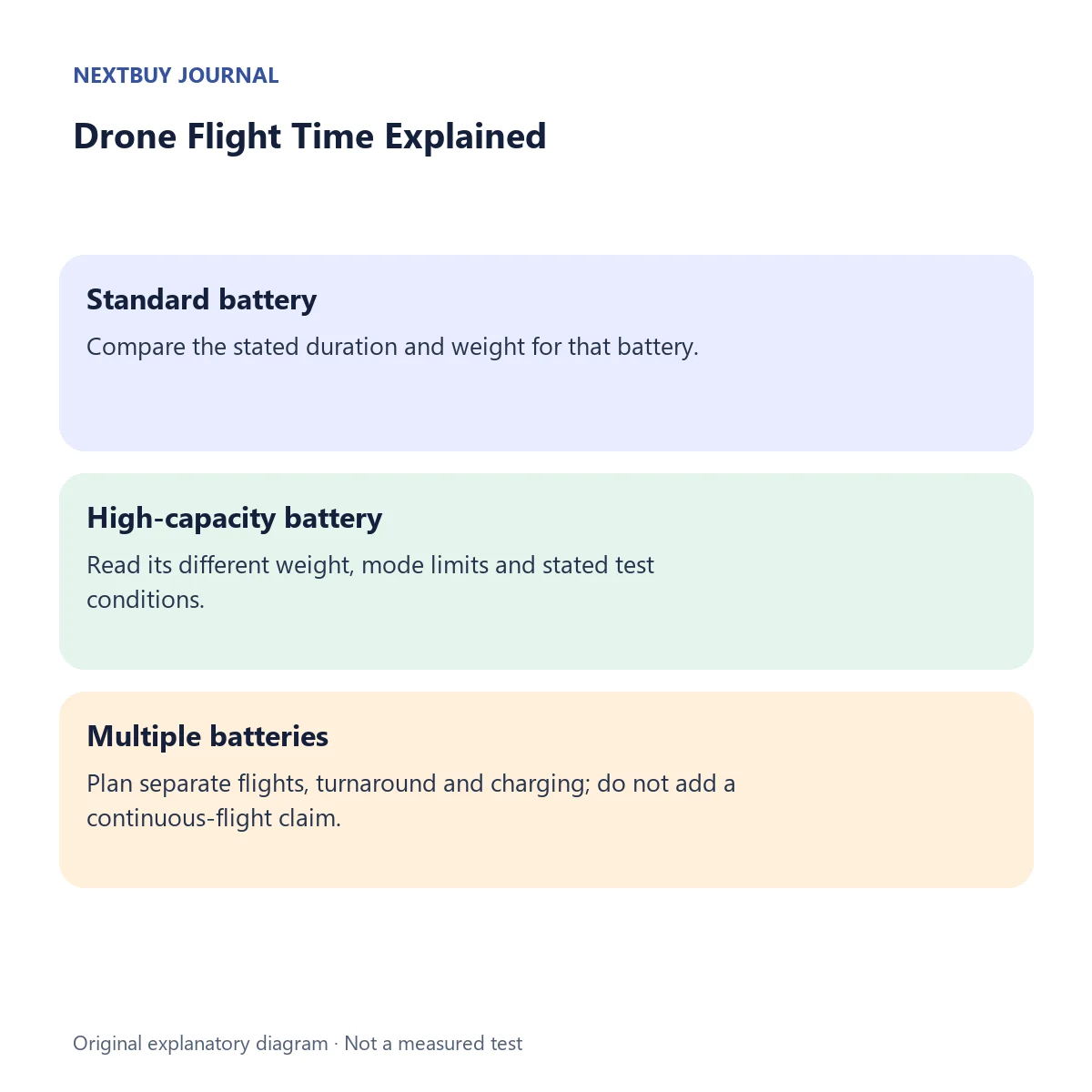
| Standard battery | Compare the stated duration and weight for that battery. |
| High-capacity battery | Read its different weight, mode limits and stated test conditions. |
| Multiple batteries | Plan separate flights, turnaround and charging; do not add a continuous-flight claim. |
Before choosing
- Identify the exact battery supplied in the selected package.
- Include return, landing and an appropriate reserve in the operating plan.
- Verify current local requirements separately from overseas product-class labels.
Questions readers ask
Does a three-battery bundle triple continuous flight time?
No. It provides separate battery cycles, with landing and turnaround between them.
Is the longest advertised time guaranteed in wind?
No. Read the manufacturer’s stated test conditions and variation caveats.